Hwayang Gugok: A Philosophical Sanctuary Carved into the Rocks and Ripples of Joseon
Nestled in the deep embrace of Goesan, Chungcheongbuk-do, Hwayang Gugok is more than a scenic wonder; it is a cultural landscape where the philosophy of the Great Scholar Song Si-yeol and the integrity of Joseon literati converge.
The landscapes of Korea possess unique narratives that transcend mere visual beauty. Among them, Hwayang Gugok (The Nine Bends of Hwayang) in Goesan is a quintessential site where Korean aesthetics and the indomitable spirit of scholars harmonize. While commonly known as 'Hwayang Valley' and popular as a summer retreat, its true value is revealed only when one deciphers the spiritual traces of the Joseon Dynasty etched into every rock and stream.
The history of Hwayang Gugok traces back to Uam Song Si-yeol, a titan of Neo-Confucianism in the late Joseon period. Here, Song spent his years in seclusion, nurturing his academic pursuits and his resolve for the 'Northern Expedition' to wash away national disgrace. His disciple, Kwon Sang-ha, identified nine scenic spots along the valley where his master resided, naming them the 'Nine Bends,' while Song himself bestowed the specific names for each. Modeled after Zhu Xi’s Mount Wuyi in China, this was an act of reimagining nature not just as a place of leisure, but as a space for seeking the Truth (Tao).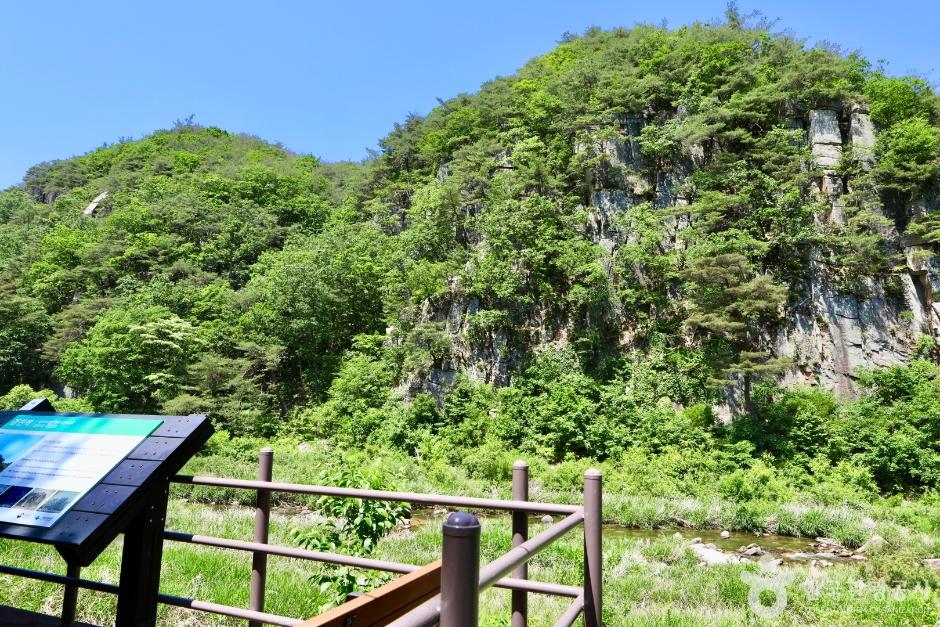 The path from the first bend, Gyeongcheonbyeok, to the ninth, Parigot, feels like walking through a traditional ink wash painting. Geumsadam (the 4th bend) is particularly renowned for its golden sands and crystal-clear waters, crowned by Amseojae, the small pavilion where Song once studied. Standing there, the cacophony of the secular world fades, replaced by the symphony of flowing water and wind. Cheomseongdae (the 5th bend), a towering rock formation said to be high enough for stargazing, also exudes a majestic presence.
From a folkloric perspective, Hwayang Gugok epitomizes the unique Korean view of nature, which linked the landscape to moral self-cultivation. The numerous inscriptions carved into the rocks speak volumes about the concerns and values held by the intellectuals of that era. This represents the essence of traditional Korean aesthetics—preserving the natural topography while infusing it with human contemplation, rather than imposing artificial structures onto the environment.
For travelers seeking a profound understanding of Korea, a journey through the winding paths of Hwayang Gugok is highly recommended. It is not merely a tourist destination for the eyes, but a breathing space where the struggles of the era’s leading scholars and their refined appreciation for nature still resonate. Washing away the dust of daily life in the clear waters of Hwayang and reflecting on the prototype of Korean beauty will undoubtedly be an invaluable experience.